KOA is preparing for the exemptions from the RoHS 2 directive to expire in mid-2027. Accordingly, numerous resistor series in thick-film technology will soon have to be offered in a lead-free version.
Current status
Exemption 7(c)-I of the RoHS 2 Directive of 2011 allowed manufacturers of electronic components such as resistors to use lead-containing compounds in their components. This meant that they did not have to comply with the maximum limit of 0.1% by weight specified in the directive. This exemption has now been extended by the European Commission until 30 June 2027.
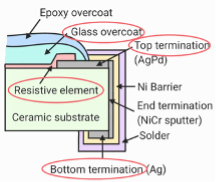
Lead is found in resistors, particularly in the form of lead-containing glass, whereby the lead is incorporated into the glass in the form of lead oxide (PbO). The cross-section illustrates the areas of a KOA SMD resistor in which the lead-containing glass is located.
These areas include (circled in red) the upper and lower terminations, the glass coating and the actual resistor element. In thick-film resistors, this consists mainly of ruthenium oxide (RuO2) and the lead-containing glass particles.
Replacing the lead oxide contained in the glass in the resistance layer poses a particular challenge for manufacturers, as the glass particles contained therein have a significant influence on the electrical behaviour of the resistor.
When manufacturers talk about “lead-free” or “totally lead-free”, this needs to be put into perspective. As already mentioned, a maximum weight percentage of 0.1% lead is still permitted even after the exemptions have been abolished. KOA will fall below this upper limit, but for technical reasons it is unlikely that there will be no lead atoms left in a resistor.
KOA’s path to “totally lead-free”
In short, KOA replaces lead with another element. However, practical implementation proves to be significantly more complex, especially when it comes to maintaining the electrical properties of the component. The aim is therefore to enable customers to replace the KOA thick-film series they have used to date with the lead-free variants without hesitation.
What is KOA’s schedule? From spring 2026 onwards, almost all KOA thick film series (RK73, SG73, WK73, WG73, HV73, SR73) will be available on the market in lead-free versions. Samples for these series are already available. Individual series such as UR73 are already lead-free or will be by early 2027 at the latest (RS73). The series designations will remain the same, but the lead-free versions will be identified by a small addition to the designation.
To make the issue even more complex, the EU Commission has issued another exemption at short notice, known as 7(c)-V. According to this exemption, lead glass may continue to be used in the resistive layer for resistors in the 1 Ω -100 MΩ range. This exemption expires on 31 December 2027. Due to the fact that KOA also uses lead glass in other areas, this exemption will have no impact on KOA’s strategy.
Based on KOA’s experience to date, customers are responding very differently to the foreseeable expiry of the exemptions. Some companies have been preparing for the changeover for months and want to have at least the approvals for the lead-free variants in place by 2026. Other companies, on the other hand, do not yet see any urgent need for action.
Depending on the scope of the components to be replaced, KOA recommends not delaying the conversion process too long.